

How Does a Hydrophilic Coating Improve Nasogastric Tube Placement?
Release time: 2026-08-07
Table of Contents
Nasogastric tube placement is a routine clinical procedure, but inserting a tube through the nasal passage and esophagus can still cause discomfort and mechanical irritation. For patients who require repeated or prolonged enteral nutrition, the insertion characteristics of the tube become an important part of overall clinical performance.
One technology receiving increasing attention is hydrophilic coating. By creating a lubricating layer when exposed to water, a hydrophilic-coated feeding tube can reduce friction during insertion and help clinicians achieve a smoother placement process.
What Is a Hydrophilic Coating on a Nasogastric Tube?
A hydrophilic coating is a surface treatment designed to become highly lubricious after contact with water or another compatible aqueous solution.
On a nasogastric feeding tube, the coating can form a hydrated film over the catheter surface. This changes the interaction between the tube and surrounding mucosal tissue during insertion.
A well-designed hydrophilic coating can provide three practical benefits:
- Lower insertion friction: The hydrated surface allows the catheter to slide more easily along the nasal and upper gastrointestinal tract.
- Reduced mechanical irritation: Less resistance may help minimize unnecessary contact and pressure against delicate mucosal tissue.
- More consistent handling: A lubricious surface can make tube advancement feel smoother and more predictable for clinical staff.
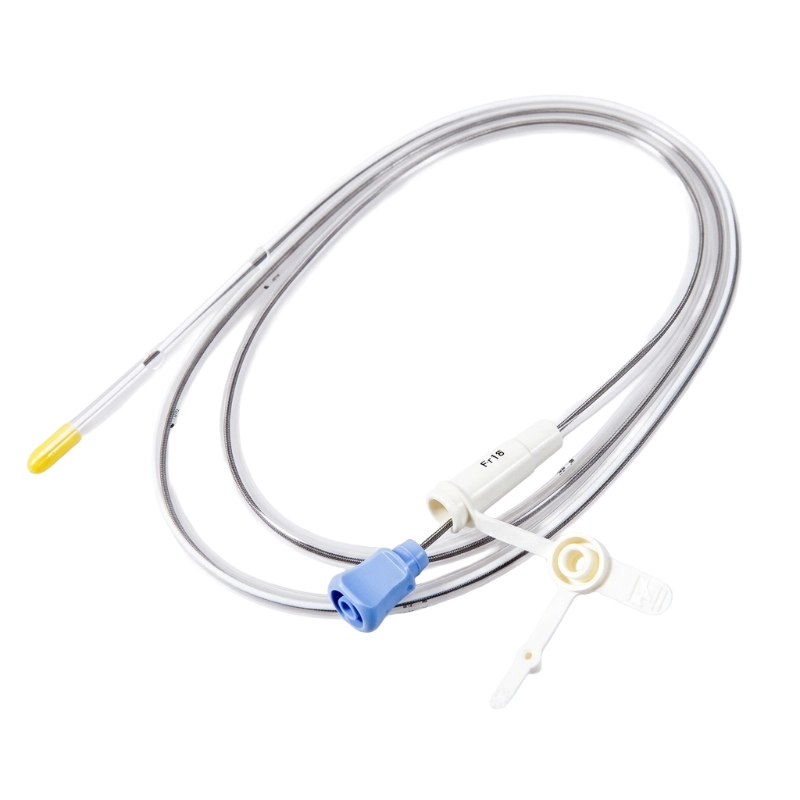
AOKOO’s Medical Grade TPU Nasogastric Feeding Tube incorporates hydrophilic coating technology at the catheter tip and is designed to reduce friction during insertion.
Why Does Insertion Friction Matter in Clinical Care?
A feeding tube may appear simple, but placement involves several anatomical transitions. The tube must pass through the nasal cavity, nasopharynx, oropharynx, and esophagus before reaching the stomach or, depending on the application, the duodenum or jejunum.
Resistance can increase when the tube surface does not provide sufficient lubrication.
This is particularly relevant for:
Patients With Repeated Tube Placement
Patients receiving ongoing enteral nutrition may need tube replacement or repositioning. A smoother insertion process can improve the overall experience for both patients and caregivers.
Patients With Sensitive Mucosal Tissue
Critically ill, elderly, pediatric, and postoperative patients may be more sensitive to mechanical irritation. Tube surface properties therefore deserve attention alongside diameter and flexibility.
Difficult Insertion Conditions
When anatomical resistance or patient movement makes placement more challenging, a tube that advances smoothly can provide better handling characteristics.
The goal is not simply to make the tube “slippery.” The coating must remain sufficiently stable on the catheter and work consistently under the intended clinical conditions.
How Does Hydrophilic Coating Work?
The mechanism is based on hydration.
When a hydrophilic surface comes into contact with water, its polymer structure interacts with water molecules and produces a hydrated layer. This layer acts as a boundary between the catheter and tissue.
| Tube Surface | Interaction During Insertion | Expected Handling |
|---|---|---|
| Uncoated surface | More direct contact with tissue | Higher friction may occur |
| Conventionally lubricated surface | Lubrication depends on external application | Performance can vary |
| Hydrophilic-coated surface | Hydrated lubricating layer forms on contact with water | More consistent low-friction handling |
This distinction is important because traditional lubrication often requires a separate lubricant to be applied before insertion. A hydrophilic coating integrates the lubricating function into the catheter surface itself.
AOKOO specifically describes its hydrophilic coating as forming a lubricating hydrogel film when exposed to water, reducing friction between the catheter and digestive tract mucosa.
Hydrophilic Coating vs Traditional Lubrication: What Is the Difference?
External lubrication remains a common approach for medical tube placement, but it adds an additional preparation step.
A hydrophilic feeding tube takes a different approach.
| Consideration | Traditional External Lubrication | Hydrophilic Coating |
| Lubrication source | Separate lubricant | Coated catheter surface |
| Preparation | Requires additional application | Activated by hydration |
| Surface consistency | Depends on lubricant distribution | Coating provides an integrated lubricating layer |
| Handling | May vary during insertion | Designed for smoother advancement |
| Clinical workflow | Additional preparation step | Simplified tube preparation |
This does not mean hydrophilic coating eliminates all placement challenges. Correct tube selection, patient assessment, positioning, lubrication activation, and clinical placement protocols remain essential.
The coating should instead be viewed as one component of a broader tube design strategy.
How Does Hydrophilic Coating Work With TPU?
Material and surface technology are closely related.
A catheter made from medical-grade TPU can provide flexibility and kink resistance, while the hydrophilic coating addresses surface friction.
AOKOO’s TPU nasogastric feeding tube combines these design elements with optional guidewire support and radiopaque lines. The product is available in multiple French sizes and can be configured for different clinical requirements.
This combination is particularly useful because insertion performance is influenced by several variables simultaneously:
- Tube flexibility
- Tip geometry
- Tube diameter
- Surface friction
- Guidewire support
- Radiopacity
- Overall catheter stiffness
Optimizing only one characteristic may not be enough. A clinically practical feeding tube needs these elements to work together.
What Other Features Should Be Considered?
Hydrophilic coating is valuable, but hospitals and medical distributors should evaluate the complete product configuration.
Radiopaque Visibility
AOKOO’s nasogastric feeding tubes can incorporate single, double, triple, or full-length radiopaque configurations depending on customer requirements. Radiopaque features support visualization under X-ray when tube position needs to be assessed.
Guidewire Compatibility
A stylet or guidewire can improve tube handling during insertion. AOKOO uses a 304 stainless-steel guidewire with a specially treated structure and rounded tip design.
Tube Size and Length
Different patients and feeding applications require different French sizes and tube lengths. Hospitals should select specifications according to clinical protocols rather than treating one configuration as universally suitable.
Connector Configuration
Connector compatibility is also important when integrating the tube with enteral feeding equipment. AOKOO offers different connector options for its nasogastric feeding tube configurations.
Why Choose AOKOO Medical for Hydrophilic Feeding Tubes?
AOKOO Medical develops enteral and gastrointestinal medical devices with a focus on practical clinical requirements. Its TPU nasogastric feeding tube integrates hydrophilic coating, radiopaque visibility, guidewire options, and multiple configuration choices into one product platform.
For hospitals, distributors, and OEM partners looking for a Hydrophilic Feeding Tube solution, AOKOO can provide configurable medical-grade products designed around insertion performance, patient comfort, and enteral nutrition requirements.
Frequently Asked Questions
What is a hydrophilic coating on a feeding tube?
A hydrophilic coating is a surface treatment that becomes highly lubricious after hydration. It forms a water-rich layer that can reduce friction between the catheter and mucosal tissue during insertion.
Does hydrophilic coating make nasogastric tube insertion painless?
No. A hydrophilic coating is designed to reduce friction and improve insertion characteristics, but it cannot eliminate discomfort or the clinical risks associated with tube placement.
Why use a hydrophilic nasogastric feeding tube?
It can provide a smoother, lower-friction catheter surface during insertion and may improve handling compared with an uncoated tube, particularly when surface lubrication is important.
Is hydrophilic coating suitable for TPU feeding tubes?
Yes. Hydrophilic surface technology can be applied to appropriately engineered medical TPU feeding tubes. The final performance depends on the coating formulation, adhesion, catheter material, and manufacturing process.
What else should be considered when choosing a hydrophilic feeding tube?
Hospitals should consider tube material, French size, length, tip design, radiopacity, guidewire configuration, connector compatibility, sterilization, and intended clinical application—not coating technology alone.