

How Can Feeding Tube Design Reduce Clogging During Enteral Nutrition?
Release time: 2026-10-15
Table of Contents
A blocked feeding tube can interrupt nutrition delivery, increase nursing workload, and require troubleshooting or tube replacement. Although flushing practices and formula characteristics are important, the design of the feeding tube itself also affects how easily material can accumulate inside the lumen.
For hospitals and medical-device buyers, reducing clogging risk requires a broader assessment of tube geometry, connector design, lumen dimensions, and intended use. No single feature can eliminate every blockage, but a well-designed system can help limit avoidable problems.
Why Do Enteral Feeding Tubes Become Blocked?
Feeding tube occlusion usually results from more than one factor. Common contributors include:
- Formula residue: Nutritional formula can remain on internal surfaces if the tube is not flushed according to the applicable protocol.
- Medication administration: Some medicines are unsuitable for crushing or may interact with feeding formula, increasing the risk of blockage.
- Inadequate flushing: Insufficient or inconsistent flushing can allow residue to accumulate.
- Small internal diameter: Narrow lumens may be more vulnerable to obstruction, depending on the formula and administration conditions.
- Structural irregularities: Abrupt transitions, joints, or internal discontinuities may create areas where material can collect.
- Improper handling: Kinking, compression, or incorrect use of connectors can interfere with flow.
A product design should therefore be evaluated together with the instructions for use and the procedures followed by the clinical team. Tube design alone cannot compensate for unsuitable medication preparation or inadequate maintenance.
How Does Tube Geometry Affect Clogging Risk?
The internal diameter, lumen shape, and transitions between different tube sections can influence flow and the potential for residue accumulation.
A tube with a relatively narrow lumen may be appropriate for a particular clinical purpose, but it can also require greater attention to formula viscosity and flushing. A larger tube is not automatically the best choice because patient anatomy, intended route, and clinical requirements also matter.
The transition between sections deserves particular attention in multi-lumen devices. When a tube changes from a dual-lumen section to a single-lumen section, an uneven junction may create a location where formula residue can collect.
A smoother transition can reduce structural discontinuities at this point. It should be viewed as a risk-reduction feature, not proof that blockage is impossible.
What Is a Smooth-Transition Feeding Tube Design?
Some dual-lumen nasogastric or nasointestinal tubes are designed to deliver nutrition through one lumen while allowing gastric decompression through another. This structure introduces a design challenge: the tube must transition between sections with different lumen configurations.
A smooth-transition design aims to minimize internal ridges and abrupt changes at the junction. By reducing irregularities that could trap residue, the design may help maintain flow under appropriate conditions.
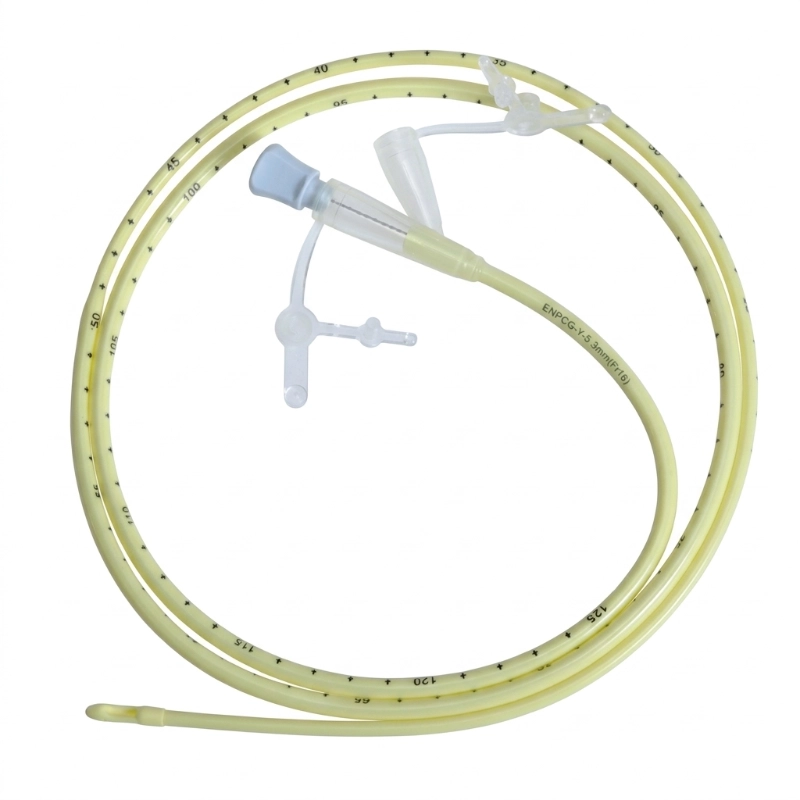
AOKOO Medical describes a Smooth-Transition junction in its dual-lumen nasogastric/nasointestinal feeding tube. The tube is designed for simultaneous enteral feeding and gastric decompression, with options including different sizes, lengths, connector configurations, and an optional guidewire.
When evaluating this feature, buyers should ask how the transition is manufactured, how the internal pathway is controlled, and what evidence supports the stated performance. Marketing language such as “anti-clog” should not be interpreted as a guarantee against all forms of occlusion.
How Do Lumen Size and Tube Configuration Matter?
French size describes the approximate external diameter of a catheter or tube. It does not directly state the internal diameter, which also depends on wall thickness and the tube’s internal construction.
For clogging risk, the internal diameter is especially relevant. However, selecting a tube solely to maximize internal diameter would ignore other clinical requirements.
| Design factor | Why it matters | What buyers should verify |
|---|---|---|
| French size | Indicates approximate external diameter | Available sizes and intended patient population |
| Internal diameter | Influences flow and passage of formula | Actual specifications, not only the Fr number |
| Lumen count | Determines whether feeding and drainage can occur through separate pathways | Intended function of each lumen |
| Transition geometry | May affect residue accumulation at junctions | Smoothness and consistency of the internal transition |
| Connector design | Affects connection security and workflow | Compatibility with the specified feeding system |
| Tube length | Influences reach and intended anatomical placement | Approved length options and intended route |
A multi-lumen tube may support more than one function, but its configuration also adds complexity. Buyers should compare the intended clinical benefit with the requirements for handling, flushing, and maintenance.
Can Material Choice Prevent Feeding Tube Blockage?
Material selection affects flexibility, durability, and the overall performance of the tube, but no material can independently prevent all blockages.
Medical-grade polyurethane is used in some feeding tubes because it can combine flexibility with the structural properties required for the intended application. The final performance still depends on tube dimensions, wall construction, lumen geometry, processing, and use conditions.
Surface characteristics may also influence how residue behaves, but a low-friction or coated surface should not be assumed to make a tube clog-proof. The device’s validated specifications and instructions for use remain the relevant references.
For procurement teams, material selection should be assessed alongside the complete design rather than treated as a stand-alone anti-clog solution.
What Practices Help Reduce Tube Occlusion?
Clinical handling remains essential even when a tube incorporates a design intended to reduce residue accumulation.
Healthcare teams should follow local protocols and the device’s instructions for use, including guidance on:
- Flushing the tube at the recommended times and with the specified fluid and volume.
- Administering medications separately when required by the relevant protocol.
- Confirming whether medicines can be safely administered through the tube.
- Avoiding forceful flushing when resistance is encountered.
- Checking tube position, patency, and external markings as required.
- Escalating persistent obstruction rather than attempting unapproved methods to clear it.
The appropriate procedure varies with patient age, clinical condition, tube type, and the substances being administered. These decisions belong to trained healthcare professionals following established protocols.
What Should Hospitals Ask a Feeding Tube Manufacturer?
For B2B buyers, a useful evaluation goes beyond the phrase “anti-clog design.” Ask the manufacturer to clarify:
- Internal geometry: How are lumen transitions and connection points designed?
- Dimensional control: What sizes and lengths are available, and how are specifications verified?
- Intended use: Is the product designed for feeding alone or for feeding plus gastric decompression?
- Compatibility: Which connectors and feeding accessories are supported?
- Performance evidence: What testing supports claims relating to patency or reduced residue accumulation?
- Documentation: Are labeling, sterilization information, quality documentation, and market-specific regulatory records available?
These questions help distinguish a meaningful engineering feature from a broad claim that cannot be assessed by the buyer.
AOKOO Medical Dual-Lumen Feeding Tube
AOKOO Medical’s dual-lumen nasogastric/nasointestinal feeding tube is designed to combine jejunal feeding with gastric decompression. The product page describes a Smooth-Transition junction intended to reduce residue accumulation at the transition between the tube sections.
Available configurations and specifications should be checked against the current product documentation. Buyers should confirm lumen function, size and length options, connector type, guidewire configuration, sterilization details, and intended indwelling duration before procurement.
Learn more about the AOKOO dual-lumen feeding tube for clinical product evaluation and sourcing discussions.
Frequently Asked Questions
What is the most common cause of feeding tube blockage?
Blockage can result from formula residue, medication administration, inadequate flushing, or structural and handling factors. The exact cause depends on the tube, the substances administered, and the clinical workflow.
Does a smooth-transition design eliminate clogging?
No. It may reduce the potential for residue accumulation at a structural junction, but it cannot prevent every blockage caused by formula, medication, or handling.
Does a larger French size always reduce clogging?
No. French size describes external diameter rather than internal diameter. Tube wall thickness and lumen design also affect the internal pathway, while patient-specific and clinical requirements determine the appropriate size.
Can a dual-lumen tube reduce blockage risk?
A dual-lumen design separates functions such as feeding and gastric decompression. Some designs also use a smooth transition between sections. These features may help address particular design-related risks, but routine maintenance and correct use remain necessary.
What should buyers request from a feeding tube manufacturer?
Request dimensional specifications, lumen and connector details, material information, intended-use documentation, sterilization information, and evidence supporting relevant performance claims.
Conclusion
Reducing feeding tube clogging requires attention to both device engineering and clinical handling. Lumen dimensions, transition geometry, connector compatibility, and the tube’s intended function should all be considered during product selection.
AOKOO Medical offers a dual-lumen feeding tube designed for simultaneous feeding and gastric decompression, with a Smooth-Transition junction intended to reduce residue accumulation. Buyers should review the product’s current specifications and supporting documentation to determine whether it meets their clinical and procurement requirements.