

How Does pH Testing Help Verify Nasogastric Tube Placement?
Release time: 2026-10-08
Table of Contents
A nasogastric tube can provide nutrition, fluids, and medication when oral intake is not possible. However, before a newly inserted tube is used, its position must be verified through an appropriate clinical procedure.
pH testing offers a bedside method for assessing gastric aspirate, while specialized devices can make the verification process more convenient. Understanding what pH testing can and cannot establish helps healthcare teams choose suitable feeding tube designs without compromising patient safety.
What Is pH Testing for Nasogastric Tube Placement?
pH testing measures how acidic a sample is. Gastric contents are generally acidic because of stomach acid, so the pH of aspirated fluid can help clinicians assess whether a nasogastric tube is positioned in the stomach.
The result is interpreted according to the applicable clinical protocol, the patient’s condition, and any factors that may affect gastric acidity. A pH result is not a universal confirmation on its own, and the procedure must follow the healthcare facility’s approved placement-verification policy.
This distinction matters because a tube may enter the respiratory tract or remain in an unsuitable position. Starting feeding before correct placement has been established can cause serious complications.
How Does a pH Test Guidewire Work?
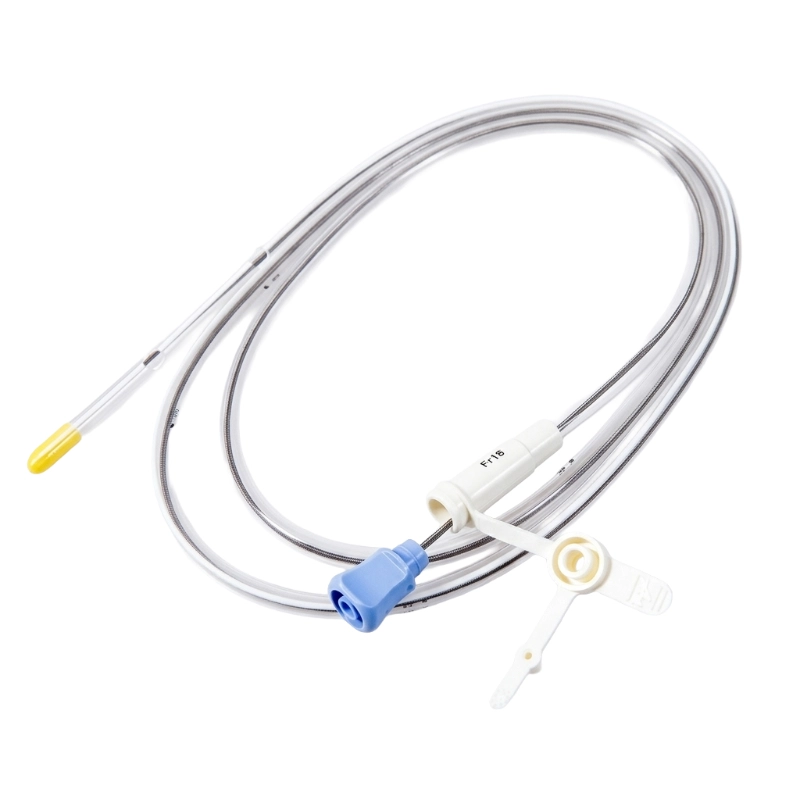
Some nasogastric tubes incorporate a pH indicator into a removable guidewire or stylet. This design is intended to support the placement-verification workflow without relying solely on a conventional gastric aspirate sample.
For a device designed with this function, the general concept is straightforward:
- Insert the tube: A trained healthcare professional places the nasogastric tube according to the relevant procedure.
- Assess the indicator: The pH-sensitive component is evaluated according to the manufacturer’s instructions.
- Interpret the result: The color change is compared with the specified reference chart.
- Confirm before use: The result is considered within the institution’s approved verification protocol. If the result is inconclusive or concerns remain, further assessment is required.
The exact procedure depends on the device design and its instructions for use. Clinicians should not assume that every guidewire contains a pH indicator or that all pH-based devices work identically.
AOKOO Medical offers a TPU nasogastric tube with a pH test guidewire. For product evaluation, buyers should review the intended use, indicator design, compatible tube sizes, labeling, and validated verification procedure.
pH Testing vs. X-Ray Confirmation
pH testing and radiography serve related but different roles in tube-placement verification. Neither should be described as a universal substitute for the other.
| Consideration | pH-based assessment | X-ray confirmation |
|---|---|---|
| Main information | Acidity of the tested sample or indicator | Anatomical course and tube position visible on the image |
| Workflow | Can support bedside assessment | Requires imaging and appropriate interpretation |
| Potential limitation | Results can be inconclusive or affected by clinical factors | Involves imaging resources and radiation exposure |
| Best use | According to approved clinical protocols and device instructions | When required by protocol or when bedside assessment is insufficient |
Radiography is widely regarded as the most accurate method for confirming initial placement when imaging is indicated. Bedside pH assessment may be used under specific protocols, but an inconclusive result or clinical concern must not be ignored. Air-bolus auscultation alone is not a reliable way to confirm tube location.
The appropriate method depends on patient risk, tube type, local guidance, and the circumstances of insertion. Hospitals should define clear escalation criteria rather than expecting one device feature to resolve every placement question.
What Can Affect pH Test Results?
Several factors may complicate interpretation:
- Medication: Acid-suppressing medicines can change gastric acidity.
- Recent feeding: Formula or other contents may affect the sample.
- Insufficient aspirate: A sample may not be available or may be too small to interpret.
- Patient-specific factors: Age, clinical condition, and gastrointestinal function may influence results.
- User interpretation: Incorrect reading of an indicator or reference chart can lead to errors.
These limitations are especially important in neonatal and pediatric care, where confirmation procedures may differ from those used for adults. The device itself cannot replace clinical judgment or a defined verification protocol.
What Should Buyers Evaluate in a pH Test Nasogastric Tube?
For hospitals, distributors, and medical-device procurement teams, selection should cover more than the presence of a pH indicator.
| Evaluation point | What to check |
|---|---|
| Intended use | Patient population and approved clinical application |
| pH indicator | Indicator material, readability, and instructions for interpretation |
| Guidewire design | Removal method, handling, and compatibility with the tube |
| Tube material | Medical-grade material and relevant biocompatibility documentation |
| Radiopacity | Whether radiopaque markers are available when required |
| Size range | French sizes and tube lengths appropriate to the intended market |
| Regulatory documentation | Applicable registration, labeling, and quality-system evidence |
A pH test feature may simplify part of the workflow, but buyers should evaluate it as one element of the complete tube design and clinical protocol.
AOKOO Medical’s pH Test Nasogastric Tube
AOKOO Medical’s pH test guidewire product combines a nasogastric tube with a pH-related placement-assessment feature. The product page also describes medical-grade TPU construction and different configurations.
For distributors and OEM buyers, the relevant questions include the available sizes, radiopaque options, connector configurations, labeling requirements, and documentation for the target market. These details should be confirmed against the current product specifications rather than assumed from a general product description.
Explore the AOKOO pH test nasogastric tube to review the available configuration and discuss procurement requirements.
Frequently Asked Questions
Does pH testing confirm nasogastric tube placement?
It can provide useful evidence under an approved clinical protocol, but results must be interpreted correctly. If the result is inconclusive or the patient’s condition raises concern, additional confirmation is required.
Can pH testing replace an X-ray?
Not in every situation. The accepted verification method depends on clinical guidance, patient risk, the tube’s intended use, and the test result. Radiographic confirmation may be required, particularly when initial placement cannot be reliably established at the bedside.
Is a pH test guidewire the same as a standard guidewire?
No. A conventional guidewire primarily supports tube insertion and handling. A pH test guidewire incorporates an additional indicator-related function, subject to the specific device design and instructions for use.
What should a hospital check before purchasing a pH test nasogastric tube?
Hospitals should review the intended use, indicator design, instructions for use, tube sizes, material documentation, radiopacity, regulatory status, and compatibility with the institution’s verification procedures.
Can pH testing detect every type of tube misplacement?
No. A pH result has limitations and should not be treated as a guarantee that the tube is correctly positioned in every circumstance. Clinical protocols must specify when further confirmation is necessary.
Conclusion
pH testing can support nasogastric tube placement assessment, but its value depends on correct interpretation and a clear clinical protocol. For medical-device buyers, a pH test guidewire is best evaluated alongside tube material, radiopacity, available sizes, instructions for use, and regulatory documentation.
AOKOO Medical provides nasogastric tube configurations for different clinical and procurement requirements. Buyers should confirm the specifications and approved use of each configuration before selection.