

Enteral Feeding Pump vs. Gravity Feeding: Which System Is Better?
Release time: 2026-10-28
Table of Contents
Enteral nutrition can be delivered through a feeding pump or by gravity, depending on the patient’s needs, the prescribed feeding regimen, and the equipment available. Neither method is universally better for every situation.
For hospitals and medical-device buyers, the key difference is how delivery is controlled. Pump systems regulate feeding according to their settings, while gravity systems rely on the height of the container, tubing configuration, and flow-control components.
What Is Pump Feeding?
Pump feeding uses an enteral feeding pump to deliver formula at a programmed rate. Depending on the device, clinicians may set a continuous or intermittent feeding schedule and monitor the delivery process.
A pump can be useful when a prescribed feeding regimen requires controlled delivery over a defined period. It may also be appropriate when the care plan calls for a relatively consistent rate that would be difficult to maintain through gravity alone.
However, pump feeding requires compatible equipment, correct setup, and adherence to the pump manufacturer’s instructions. The pump does not determine whether a feeding regimen is clinically appropriate; that decision belongs to the healthcare team.
What Is Gravity Feeding?
Gravity feeding delivers formula from a container positioned above the patient. The fluid moves through the tubing under gravity, while the flow rate is managed according to the feeding set design and clinical procedure.
A gravity feeding set may be suitable when the prescribed regimen allows this method and the healthcare team can manage the delivery process appropriately.
The actual flow rate can vary with the height of the container, formula characteristics, tubing dimensions, and flow-control settings. Gravity feeding should not be assumed to provide the same rate control as a pump.
Pump Feeding vs. Gravity Feeding: Key Differences
| Consideration | Pump feeding | Gravity feeding |
|---|---|---|
| Delivery control | Rate can be programmed within the pump’s capabilities | Flow depends on gravity and the set’s control components |
| Equipment | Requires a compatible feeding pump and set | Requires a compatible gravity feeding set and container |
| Setup | Pump programming and device checks are needed | Container positioning and flow adjustment are important |
| Flexibility | Useful for prescribed controlled-rate regimens | Useful where the prescribed regimen permits gravity delivery |
| Monitoring | Requires pump and feeding-system monitoring | Requires monitoring of flow and patient tolerance |
| Procurement | Pump compatibility and service requirements matter | Set configuration and connector compatibility matter |
The choice should be based on the prescribed regimen and clinical circumstances, not on a blanket claim that one system is safer or more effective for all patients.
When Is Pump Feeding a Suitable Option?
Pump feeding may be considered when a patient requires controlled delivery according to a specific clinical plan. It can help the care team maintain a prescribed rate and schedule, subject to the pump’s capabilities and correct setup.
Factors that may support pump use include:
- A feeding regimen that specifies a controlled delivery rate.
- A clinical need to administer formula over an extended period.
- A requirement to use equipment compatible with the prescribed enteral nutrition system.
- A care environment where staff can configure, monitor, and maintain the pump appropriately.
The patient’s condition, prescribed formula, and tolerance should guide the decision. A pump should not be selected solely because it appears more technologically advanced.
When Is Gravity Feeding a Suitable Option?
Gravity feeding may be appropriate when the prescribed regimen allows formula to be delivered without a pump and the patient can tolerate the intended method.
Potential considerations include:
- Whether the prescribed feeding schedule is compatible with gravity delivery.
- Whether the feeding set supports the required container and connector.
- Whether staff can manage container height and monitor flow.
- Whether the patient and care environment can accommodate the chosen method.
Because gravity flow is influenced by several physical factors, the actual delivery rate may vary. The care team should follow the feeding protocol and the manufacturer’s instructions rather than assuming that the roller clamp alone guarantees a precise rate.
Why Does the Feeding Set Matter?
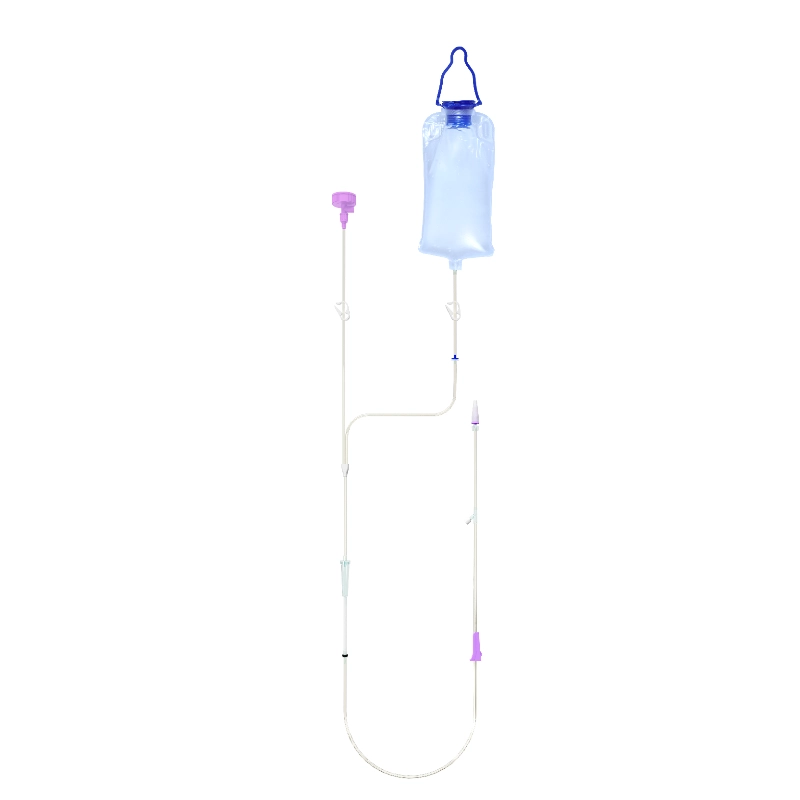
The feeding set is a functional part of the delivery system. A suitable set must connect the formula container to the enteral access device and support the intended delivery method.
Important design considerations include:
- Connector compatibility: The set must connect to the intended enteral device without unsafe or unsuitable adapters.
- Tubing configuration: Length, tubing material, and control components should match the intended use.
- Container interface: The spike or bottle adapter must be suitable for the formula container.
- Access ports: A Y-connector or other port may support specified procedures, subject to the product instructions.
- Capacity: The bag or container capacity should match the prescribed workflow.
- Material documentation: Buyers should verify the material specifications and relevant safety documentation for the actual product.
ENFit-compatible components are designed for enteral-specific connections under ISO 80369-3. Compatibility must be checked across the complete system, including the feeding set, tube, syringe, and any pump-specific components.
What Should Hospitals Consider When Buying Feeding Sets?
Hospitals and distributors should evaluate feeding sets against their intended delivery method and existing equipment.
| Procurement criterion | Questions to resolve |
|---|---|
| Delivery method | Is the set designed for pump use, gravity use, or both where specified? |
| Connector standard | Is the connector compatible with the intended enteral system? |
| Container interface | Does the set support the required bottle, bag, or formula container? |
| Tubing length | Is the length suitable for the intended setup? |
| Capacity | Are the available bag sizes appropriate for the workflow? |
| Materials | Are the materials and applicable safety claims documented? |
| Sterility and shelf life | What does the current product labeling specify? |
| Pump compatibility | Is compatibility confirmed for the specific pump model where required? |
A product listing that mentions both pump and gravity use does not necessarily mean that every individual configuration can be used interchangeably. Buyers should verify the specifications for the exact model being purchased.
AOKOO Medical ENFit Enteral Feeding Sets
AOKOO Medical offers ENFit enteral feeding sets for gravity and pump applications. The product page describes configurations with different bag capacities and components, including tubing, a drip chamber, a roller clamp, and connector options.
For B2B procurement, confirm the exact model, intended delivery method, connector configuration, materials, capacity, sterilization information, and compatibility requirements. Pump compatibility should be checked against the particular equipment being used rather than inferred from a general product description.
Frequently Asked Questions
Is pump feeding better than gravity feeding?
Not in every situation. Pump feeding offers programmed rate control, while gravity feeding may suit regimens that permit gravity delivery. The prescribed feeding plan and patient’s clinical needs determine the appropriate method.
Does gravity feeding provide a fixed flow rate?
No. Flow can vary with container height, formula properties, tubing configuration, and flow-control settings. Follow the applicable clinical procedure and device instructions.
Can the same feeding set be used with a pump and by gravity?
Only when the specific product is designed and labeled for both methods. Buyers should verify the instructions for use and model-specific compatibility.
What does ENFit mean for a feeding set?
ENFit is an enteral connector system associated with ISO 80369-3. It is intended to reduce the risk of misconnections between enteral and other medical connection systems. It does not, by itself, determine the delivery rate or feeding method.
What should distributors check before ordering an enteral feeding set?
Check the delivery method, connector standard, container interface, tubing configuration, capacity, material documentation, sterilization details, and any equipment compatibility requirements.
Conclusion
Pump and gravity feeding serve different operational needs. A pump can provide programmed rate control, while gravity feeding may be suitable when the prescribed regimen allows a gravity-based method. Neither approach should be selected without considering the patient, feeding plan, and available equipment.
AOKOO Medical offers ENFit enteral feeding set configurations for gravity and pump applications. Hospitals and distributors should confirm model-specific specifications and compatibility before purchasing to ensure the selected set matches the intended workflow.